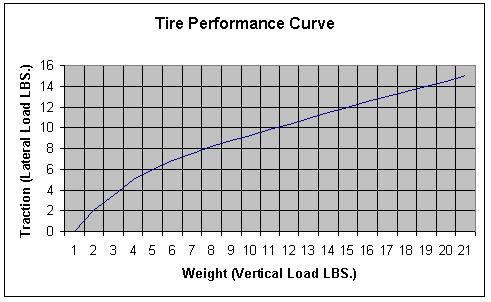
Figure 1
Figure 1
Understeer & Oversteer
Car Weight: |
30 lbs. |
Front End Weight: |
50 % |
Left Side Weight Bias: |
0 |
Load Transfer From Cornering: |
0 |
Tire Location |
Static Weight On Tire |
Traction Available |
Left Front |
7.5 lbs. |
8.2 lbs. |
Right Front |
7.5 lbs. |
8.2 lbs. |
Left Rear |
7.5 lbs. |
8.2 lbs. |
Right Rear |
7.5 lbs. |
8.2 lbs. |
Total |
30 lbs. |
32.8 lbs. |
Total Cornering Force = Traction / Weight
= 32.8 / 30
= 1.093 g's
Tire Location |
Static Weight |
Lateral Weight Transfer |
Weight On Tire During Cornering |
Traction Available |
Left Front |
7.5 |
-5.625 |
1.875 |
2.25 |
Right Front |
7.5 |
+5.625 |
13.125 |
11.5 |
Left Rear |
7.5 |
-5.625 |
1.875 |
2.25 |
Right Rear |
7.5 |
-5.625 |
13.125 |
11.5 |
Total |
30 |
N/A |
30 |
27.5 |
If we assume and factor in a 1.0 g cornering force we can reduce the equation to:
= (30 lbs x 6 inches) / 16 inches
= 180 / 16 = 11.25 lbs.
This means 11.25 lbs. will be transfered from the inside tires to the outside tires during cornering. With equal front-to-rear or 50/50 weight distribution, 5.625 lbs. will be transfered from each inside tire to each outside tire. So how much total traction would be avalable to us in the turn? Well our inside tires would have 1.875 lbs. of vertical loading and our outside tires will have 13.125 lbs. If we look at Figure 1 we will see that the inside front and rear tire will have 2.25 lbs. of available traction and the outside front and rear will have approximately 11.5 lbs. of available traction. for a total of 27.5 lbs.
How much cornering force do we have?
Our cornering power was decreased from 1.093 g's to 0.92 g's, a difference of .173 g's due to lateral weight transfer. A pretty significant difference in that Static and Dynamic force I would say. One way to decrease the effect of this shifting lateral weight is with preloading. Preloading is the deliberate movement of predetermined weight to a predetermined location, such as moving existing weight from the outside tires to the inside tires for us "Circle Jerks". Which brings us to our third example.
This shows how, by increasing or positive biasing the left side weight of the car by negatively biasing the right side weight we can improve our cornering force. So far we have maitained a 50/50 weight ratio front-to-back. What happens when we bias the front end?
Tire Location |
Static Weight |
Lateral Weight Transfer |
Weight On Tire During Cornering |
Traction Available |
Left Front |
9 |
-6.75 |
2.25 |
1.75 |
Right Front |
9 |
+6.75 |
15.75 |
12.5 |
Left Rear |
6 |
-4.5 |
1.5 |
2 |
Right Rear |
6 |
+4.5 |
10.5 |
9.5 |
Total |
30 |
N/A |
30 |
25.75 |
= 25.75 / 30
= .86 g's
Example Three Revisited (Preload)
Tire Location |
Static Weight |
Lateral Weight Transfer |
Weight On Tire During Cornering |
Traction Available |
Left Front |
12.5 |
-5.625 |
6.875 |
7.5 |
Right Front |
2.5 |
+5.625 |
8.125 |
8 |
Left Rear |
12.5 |
-5.625 |
6.875 |
7.5 |
Right Rear |
2.5 |
+5.625 |
8.125 |
8 |
Total |
30 |
N/A |
30 |
31 |
Static Weight on each right tire is 2.5 lbs.
Static Weight on each left tire is 12.5 lbs
Lateral Weight transfer on each right tire is +5.625 lbs.
Lateral Weight transfer from each left tire is -5.625 lbs.
Weight on each right tire during cornering is 8.125 lbs.
Weight on each left tire during cornering is 6.875 lbs.
Traction Available on each right tire is 8 lbs.
Traction Available on each left tire is 7.5 lbs.
Total Cornering Force = Traction/ Weight = 31 lbs. / 30 lbs. = 1.03 g's
So now you see how preloading can enhance cornering ability. Simply by preloading the left side by 10 lbs. we have gone from 0.83 g's to 1.03 g's. Now with a little playing around with the weights we could get the car absolutely perfectly balanced.
Tire Location |
Static Weight |
Lateral Weight Transfer |
Weight On Tire During Cornering |
Traction Available |
Left Front |
14 |
-6.75 |
7.25 |
8 |
Right Front |
4 |
6.75 |
10.75 |
9 |
Left Rear |
11 |
-4.5 |
6.5 |
7.5 |
Right Rear |
1 |
4.5 |
5.5 |
7 |
Total |
30 |
N/A |
30 |
31.5 |
Did we fix the understeer problem?
Front cornering force = Traction / Weight = 17 / 18 = 1.06 g's
Rear cornering Force = Traction / Weight = 14.5 / 12 = 1.17 g's
In this case no. Our front cornering force is still less than our rear, so we didn't fix the problem.
In this last example we are going to see the effects of wedge. Keeping all other parameters the same as Example Five, we are going to add 2 lbs. of weight to the right rear tire.
Assume our 30 lb. car has the following after adjusting to neutral static condition:
Wedge Weight: 2 lbs.
Front End Weight: 60%
Left Side Weight Bias: 10 lbs
Load Transfer from Cornering: 11.25
Tire Location |
Static Weight |
Lateral Weight Transfer |
Weight On Tire During Cornering |
Traction Available |
Left Front |
16 |
-6.75 |
9.25 |
9.25 |
Right Front |
2 |
6.75 |
8.75 |
8.75 |
Left Rear |
9 |
-4.5 |
4.5 |
6 |
Right Rear |
3 |
4.5 |
7.5 |
8 |
Total |
30 |
0 |
30 |
32 |
Now work the formula for the total cornering force, then just for the front and rear.
Total Cornering Force = Tcf = 32 / 30 = 1.07 g's

Front Cornering Force = Fcf = 18 / 30 = 0.60 g's

Rear Cornering Force = Rcf = 14 / 30 = 0.47 g's
This is what I am going to do, just to see how much interest there is or isn't in these articles, you figure these out for yourself, email me your answers, stevestevens@verizonmail.com, and if there is enough interest (at least 10 different people) I will continue the articles.
1) Assuming the tire sizes are equal at all four corners, the best cornering power is achieved when front-to-back weight distribution is equal.
2) Left side bias increases cornering power for oval tracks (also assuming a counter-clockwise direction)
3) Cars with only front end bias will tend to understeer while cornering.
4) Wedging can reduce understeer in the corners and produce faster cornering.
5) The best cornering power will be when all four tires have equal weight during cornering, generally speaking.
I hope you are enjoying these articles. Until next time, keep the shinny side up.