I am not a self-proclaimed expert on tuned pipes or any of the other areas I have discussed In these pages. I am attempting to assemble information and explain, in a lay-persons terms, things that must be understood in order to achieve satisfactory performance from our 2-stroke engines.
It has been said that the single most performance gain that one can achieve is by strapping on a tuned pipe. This is very true if it is done properly. Don't just go down to your hobby shop and purchase a pipe marked ".21 Tuned Pipe" or ".45 Tuned Pipe", it's not that easy unless of course the pipe happens to be manufactured by the same company that made your engine. Which still doesn't guarantee that you will achieve optimum performance for your application. Remember that a pipe is determined by RPM not engine size.
What are the sections of a tuned pipe called? What does each section of the pipe do? What are negative and positive sound waves? What won't a pipe do? These are some of the questions I will try to answer here.
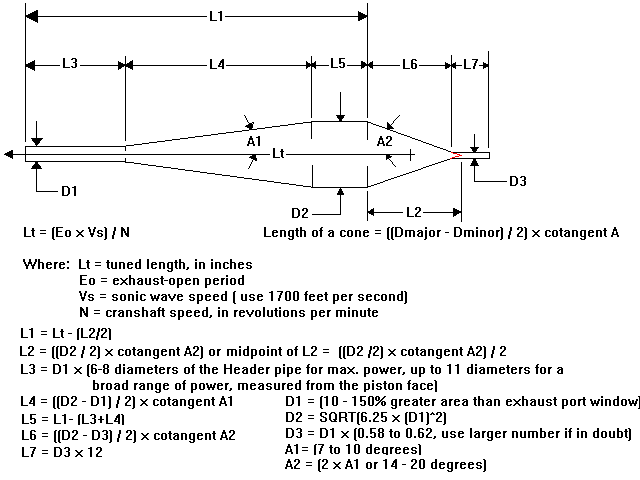
Header - Attaches to the engine and is the straight or slightly divergent (opens up 2-3 degrees) section of the pipe. It helps to suck the exhaust gases out of the engine. The header pipe cross-sectional area should be 10-15% greater than the exhaust port window for when maximum output at maximum RPM's is desired. In some cases the area of the header pipe may have a cross-sectional area 150% of the exhaust port area. the length should be 6-8 of its diameters for maximum horsepower, for a broader power curve 11 times pipe diameter may be used. The part you trim off to tune.
Divergent (Diffuser) Cone - The section of the pipe that attaches to the header and opens up at an angle like a megaphone. It intensifies and lengthens the returning sound waves thus broadening the power curve. The steeper the angle the more intense the negative wave returns, but also the shorter the duration. The lesser the angle, of course, returns a less intense wave, but for a longer period of time (duration). The outlet area should be 6.25 times the inlet area. 7-10 degree taper angle.
Belly - Located between the divergent and convergent cones, it's length determines the relative timing of the negative and positive waves. The shorter the belly the shorter the distance positive waves travel and the narrower the RPM range. This is good for operating at HIGH RPM only. The longer the belly the broader the RPM range. The diameter of the belly has little or no effect.
Convergent (Baffle) Cone - Located after the belly and before the stinger, reflects the positive waves back to the open exhaust port and forces the fresh fuel mixture back into the combustion chamber as the exhaust port closes. The steeper the angle the more intense the positive wave and the gentler the angle the less intense. 14-20 degree taper angle. The taper angle primarily influences the shape of the power curve past the point at which maximum power is obtained.
Stinger - Located at the opposite end of the pipe from the header and after the convergent cone, it is the "pressure relief valve" of the pipe where the exhaust gasses eventually leave the pipe. The back pressure in the pipe is caused by the size (diameter) or length of the stinger. A smaller stinger causes more back pressure and thus a denser medium for the sound waves to travel in. Sound waves love denser mediums and thus travel better. A draw back to a small stinger is heat build up in the pipe and engine. DO NOT USE TOO SMALL A STINGER! The stinger diameter should be .58-.62 times that of the header pipe and a length equal to 12 of it's own diameters.
When your engine fires it detonates the fuel mixture in the combustion chamber, pushes the piston down, opens the exhaust port and allows the burnt gases to escape along with the sound wave produced when the engine fired. The negative sound waves pull the exhaust gasses out of the exhaust port. The positive sound waves, reflected back from the convergent (baffle) cone, force the fresh fuel mixture back into the combustion chamber through the exhaust port thus super-charging your engine.
Here are the formulas from Gordon Jennings' book "2-Stroke Tuners Handbook". (Should have given credit before.)
When using the formulas above for designing or calculating what parameters the pipe to buy should have, the first step is to calculate D1. When you calculate D1 with the D1 formula above, remember that the number is in sq-in and must be converted to the diameter of the header pipe. Do this by dividing your calculation by Pi and then taking the square root. This will give you the radius of the header. Just multiply it by 2 to get the diameter. What you are doing is working the formula for the area of a circle backwards (Area of a circle = Pi r^2). From this point on, no other conversion should be necessary unless you use metric (Multiply numerator of L
T
formula by 83.3 and use 518.16 m/s for V
S
to get mm instead of inches) instead of English.
IMPORTANT!!!
For comparison here are the formulas from Martin Hepperle's "Airfoils" page. (Updated to reflect Martin's correction to typo.)
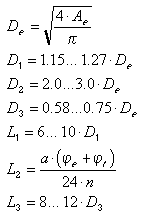
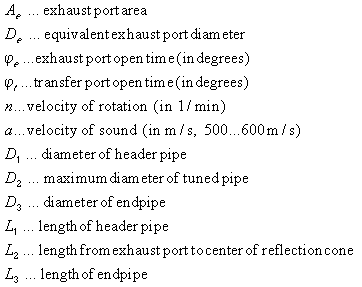
Notice differences in some of the formulas? This may be due to new research and when the formulas were derived (1973 for Jennings' reference and 1997 for Hepperle's.)
An ideal tuned pipe is thought to have a gently divergent header pipe to keep exhaust gases at a high velocity near the exhaust port opening, then a second medium diverging cone and a third high diverging cone attached to the belly. In reality it is what works for you. So how do you determine all these things? One at a time. Let's look at setting up an engine for course racing.
What do we want?
1) Quick acceleration
2) Broad RPM range
3) Broad to lower power range
This means we are probably not going to turn the maximum RPM's that the engine is capable of anywhere on the course. If our engine is capable of turning 25,000 RPM's, we will probably only use up to 20,000 RPM's. Look at each section of the pipe in the above descriptions. The Header cross-sectional area should be at least 10-15% greater than the area of the exhaust port. Length at this point doesn't really matter (at least 8 diameters), but make sure it is long enough to work with. The divergent cone would be at a medium angle for a broad power curve at lower RPM's. The belly would be medium to long for a broad RPM range. The convergent cone would be at a gentle angle because we want the duration of the positive wave to be longer.
How long is the pipe? If we go back to the Formulas Page and get the formulas for Exhaust Systems Tuned Length and Length of Curved Pipe (if you need to calculate a curved pipe) we can calculate closely the pipe length. The formula for determining the length is:
L
t
= (E
o
x V
s
) / N English
OR (83.3(E
o
x V
s
)) / N Metric
L
t
= tuned pipe length, in inches
E
o
= exhaust open period, in degrees
V
s
= wave speed (1700 ft/sec
N = crankshaft speed, in RPM
Let's say, for example, we have an engine that will turn 25,000 RPM. We calculate that we will only use 20,000 of those RPM's and our exhaust duration is 180 degrees. Then we substitute in the formula:
L
t
= (180 x 1700) / 20,000
L
t
= 15.3 inches
Now this is where you need to make a personal decision.
Some people say that this distance is measured from the exhaut port opening and some
say that the distance is from the center of the cylinder. The choice is yours,
but I take the longer distance, which is from the exhaust port opening.
Remember that this is not the total length of the pipe. This is the length from
the (in my choice) face of the piston at the exhaust port to the center of the
convergent cone including the invisible intersection of the convergent points not
just what you see. Go back to the
Formulas Page
and get the formula Baffle Cones to determine this point.
A fun little JAVA script Tuned Pipe Design program can be reached from my home page.
I have used broad terms here, such as gentle angle and steep angle, long and short, but what is gentle, steep, long and short. Well I don't really know myself. All I can suggest is ask others what works for them, look at the pipes others use and how their planes/boats/cars perform and examine the pipes in your local hobby shop. Get in touch with the manufacturer or distributer for your engine and ask them. I do know that some 40-45 engines will use a pipe designed for 60-65 engines VERY well.
Update Note - As a general rule the convergent cone should have twice the angle of the divergent cone and the largest taper angle you should use is 20 degrees and the smallest is 14 degrees. That means the divergent cone should be no more than 10 degrees and no smaller than 7 degrees.
Now comes the fun part! We get to go to the lake/flying site/road course again, unless of course we have our very own dyno. Not. So we have set the pipe up so that we have an optimum length. Well take it off! That's right, take it off. First we want to get the right prop, right fuel and right needle before we even mess with that pipe. You see this is where the "What a pipe can't do?" comes in. A pipe cannot make up for poor engine setups and crappy props. A pipe also cannot make up for bad engine timing and some engines are timed so poorly that no pipe will increase performance. Ok, we make a few runs without the pipe. We have the right prop, the right needle setting and this is the fuel we are going to be racing with. Put the pipe back on richen the needle a little (1/4 turn) and make a run. We pay close attention to what the engine is doing. If the engine turns slower, something is wrong, if the mixture is correct the pipe is too long. Shorten it by 1/8" at a time until the revs start to rise. If the pipe is too short the motor will run harshly and the needle setting will be unstable and critical. Add 1/8" to the length at a time. When the pipe is at the proper length you will experience the thrill of a lifetime. You will hear the engine and pipe become one in resonance. You will see your boat/plane/car accelerate like you walked behind it and gave it a kick in the rear. Bring it in, settle down and have a cold brewski and rejoice. You have succeeded in tuning that pipe.!!!
Send Feedback to

steve.stevens.bbq@gmail.com
